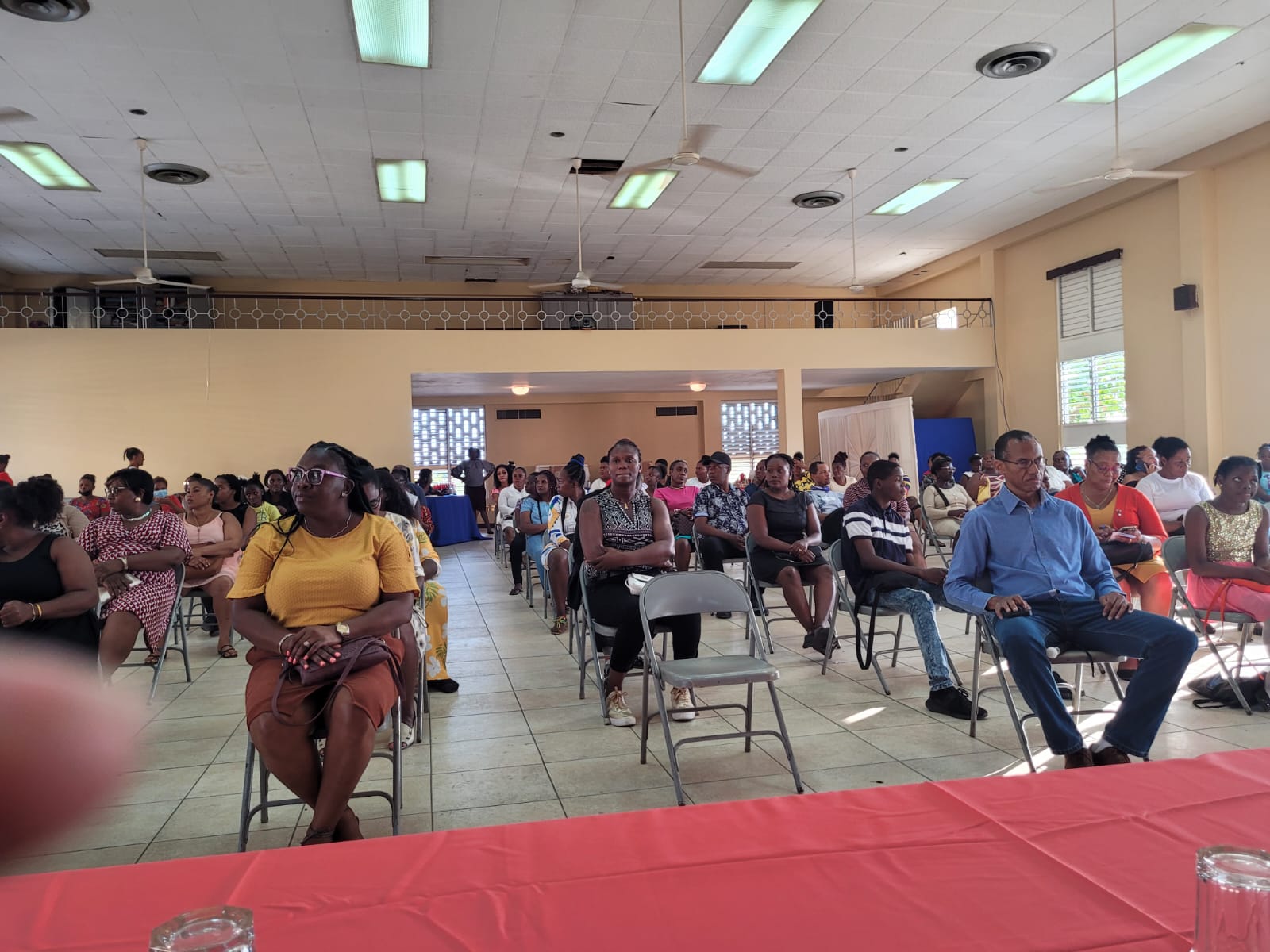
Parenting Commission Seeking Stakeholder Support for Post-Hurricane Recovery Mission

The National Parenting Support Commission (NPSC) is encouraging organisations involved in humanitarian outreach across areas most affected by Hurricane Melissa to collaborate with the Commission and its network of more than 700 parent mentors.

Chief Executive Officer, Kaysia Kerr, explained that the Commission has been coordinating with various groups distributing relief supplies. “As packages are shared, we accompany them and extend the support being offered by providing psychosocial care,” she noted.

The Commission completed its first outreach in St. Elizabeth last week and will return to the parish this Saturday as activities continue.

“We will keep going until we are confident that meaningful progress has been made,” Ms. Kerr said.

She was speaking at the official Recovery Mission launch for National Parent Month on Wednesday, November 12, at Tivoli Gardens High School in Kingston.

Parent Month 2025, observed throughout November, is centred on the post–Hurricane Melissa recovery mission under the theme Stronger Parenting Together.

Ms. Kerr highlighted the value of psychosocial care during this period. “This kind of support cannot be overstated. People want to talk, to feel that others genuinely care. They want space to share their experiences, the trauma they’ve endured, and to receive guidance toward setting goals,” she emphasised.

Permanent Secretary in the Ministry of Education, Skills, Youth and Information, Dr. Kasan Troupe, encouraged parents to participate actively in the national recovery efforts.

“It could be a reassuring gesture, your presence, or offering support to someone in need. Whatever you choose to do, consider what Jamaica is facing and get involved. Let us rebuild stronger,” she urged.

Organisations interested in partnering with the NPSC may contact the Commission at 876-788-5606.

Credit: Originally published by the Jamaica Information Service (JIS)

Parenting Support Helplines Assisting Parents in Recovery Process

The National Parenting Support Commission, (NPSC), has expanded its helpline network to provide additional support to parents affected by Hurricane Melissa. This is part of NPSC’s ongoing efforts to ensure that parents receive timely psychosocial and practical guidance throughout the recovery period.

For immediate support, the parenting support helplines can be reached at (876) 788-5606, (876) 854-9010, (658) 213-2631 and (658) 213-2625. All numbers are fully operational and staffed by trained professionals who provide assistance, referrals to essential services and guidance on managing challenges in the aftermath of the hurricane. Parents can also reach out via WhatsApp text messaging using any of these numbers.

Chief Executive Officer Ms. Kaysia Kerr stated that the expansion reflects NPSC’s commitment to supporting parents as they rebuild and adapt to changing circumstances.

“In times of crisis, parenting becomes even more complex. The NPSC is ensuring that parents are not navigating this period alone. Our helplines offer a space to talk, seek guidance and be connected to resources that support both emotional and practical recovery,” said Ms. Kerr.

The helplines operate Monday to Friday from 8:00 a.m. to 5:00 p.m. They provide a safe space to seek guidance and support in navigating post-disaster stressors. Parents are encouraged to contact the helplines for assistance or to share information that may benefit others within their network.

NPSC Seeks to Introduce Accreditation Framework for Parenting Support Services

Kingston, Jamaica – The National Parenting Support Commission ,(NPSC), seeks to introduce an Accreditation Framework to strengthen and standardise parenting support services across Jamaica. The framework is designed to ensure parents have reliable access to effective and evidence-based programmes that support parents in their role.

The framework establishes national standards for organisations and practitioners offering parenting programmes and support services. It  provides guidance for programme objectives, governance, ethical practices and overall effectiveness. The NPSC will oversee the process, which is intended to promote consistency, accountability and ongoing improvement in programme delivery.

Parenting support services have historically varied in approach and quality, which has led to inconsistent access, particularly for parents who are in underserved communities. The framework is intended to address these gaps by ensuring services meet national standards, align with best practices, and contribute to strengthening parental capacity and improving outcomes for children.

The Accreditation Framework benefits both parents and service providers. Parents can access programmes that meet recognised standards, while providers receive guidance, training opportunities and recognition. Providers seeking accreditation will participate in a structured review process that examines programme objectives, governance, ethical practices, and service delivery. Accredited programmes will be publicly recognised to provide parents with a trusted reference point and to encourage continuous improvement among providers.

“The Accreditation Framework seeks to raise the standard of parenting support in Jamaica,” said Kaysia Kerr, Chief Executive Officer of the NPSC. “Parents deserve high-quality services, and this framework equips providers to deliver them consistently. Stronger parents build stronger parent-child relationships, which contribute to stronger communities and a stronger nation.”

The NPSC is inviting all providers of parenting support services to begin preparing for the accreditation process. Standardising service delivery and strengthening programme quality is an important step in fostering accountability, professionalism and consistent support across the sector.

NPSC Urges Parents to Stay Connected During Children’s Transition to High School

With the new school year just one week away, the National Parenting Support Commission ,(NPSC), is appealing to parents to remain closely connected with their children, especially those preparing to enter high school.

The transition from primary to secondary school is a significant milestone. It brings heightened academic expectations, exposure to new peer groups and the challenge of adjusting to a different social environment. According to the NPSC, this is precisely the stage when children need their parents’ steady presence, guidance and emotional support.

“Transitioning to high school can be both exciting and overwhelming for students,” notes Kaysia Kerr, Chief Executive Officer of the NPSC. “It is at this stage that children need their parents most: listening, guiding and staying connected.”

The Commission stresses that strong parental involvement helps children feel secure, make better choices and adjust more confidently to the demands of their education life journey. Staying connected also keeps communication open, allowing parents to identify challenges early while providing encouragement and reassurance.

To strengthen this connection, the NPSC continues to offer Parenting Education Sessions (PES), designed to equip parents with strategies for effective communication and balance at home. Yet, as the agency reminds, connection goes beyond the home. Parents are encouraged to set high expectations, discuss them with their children and work in partnership with schools. Research consistently shows that when parents maintain a positive relationship with the school, students behave better and achieve more academically.

This partnership becomes especially important during the teenage years. At this stage, peers exert a powerful influence, as teenagers may feel a deep need for social acceptance. The NPSC is urging parents to be mindful of this, to validate their children’s feelings and to listen with the aim of guiding rather than dismissing. Conversations should never be a trap but an opportunity to build trust and offer direction.

To support this, the NPSC has encouraged schools to adopt its Model for Parental Involvement in Education, which goes beyond attendance at events and fundraising. The model positions parents as active partners in the education life journey of their children. This includes asking about the curriculum to better support learning at home, joining projects that not only aid academic growth but also improve the school’s environment, volunteering through the PTA and serving as resource persons to strengthen classroom experiences. Parents are also encouraged to take advantage of NPSC-established programmes available in schools and participate in the Parenting Education Sessions (PES). By embedding parental involvement in the school improvement plan, schools create intentional opportunities for parents to contribute meaningfully to their children’s education and overall development.

Staying connected therefore requires a conscious and consistent effort across these areas. Ms Kerr emphasises that when parents take on this level of engagement, children are more likely to thrive academically, socially and emotionally. “A successful transition requires more than school readiness,” she says. “It requires parental presence.”

As the new school year begins, the NPSC is renewing its call: Stay connected. Stay engaged. Stay present. The journey into high school is not only your child’s, it is a shared journey and parental support can make all the difference.

NPSC Moves to Strengthen Parenting Sector Through Partnerships

The National Parenting Support Commission ,(NPSC), as one of the Government of Jamaica’s engines for the transformation of the education sector, has intensified its outreach to equip parents with the knowledge, skills and resources as part of its urging for parental involvement in education. 

Parenting within the context of the village was a part of Jamaica’s national identity. Once rooted in the saying “It takes a village to raise a child,” households have traditionally relied on the support of relatives, neighbours, and community elders to nurture children. This community-driven approach has shaped values, preserved traditions, and built resilience for generations.

Today the “village” looks different. Migration, changing household structures, economic pressures and global influences have reshaped how parents raise their children. While love and dedication remain strong, modern parents face new challenges. Balancing work and home life, guiding children in a digital age and addressing mental health are now part of the parenting reality. These changes have moved parenting from being a private household matter to a national development priority.

In recent years, Jamaica has seen a growing demand for structured parenting support. Community groups, schools, faith-based organisations, and non-governmental bodies have been working on the ground to help parents navigate challenges at home. These efforts have not only met immediate needs but have also highlighted the importance of having more targeted parenting initiatives.

Together, these activities form what is known as the parenting sector, a network of people and organisations committed to building parenting capacity so that parents can be more effective in parenting. The sector’s work spans promoting positive discipline and increasing parental involvement in education through structured programmes established in schools and communities.

It is a collaborative space, but like any large network, it needs direction and coordination to reach its full potential. This is where the National Parenting Support Commission plays its part.

Established under the National Parenting Support Commission Act, 2012, the NPSC is an agency of the Ministry of Education, Youth, Skills and Information mandated to coordinate and streamline parenting support initiatives across the island and develop a national standards and accreditation system for the delivery of parenting support services. The Commission provides training and resources for parents while building stronger partnerships between home, school, and community.

At present, many organisations have a misunderstanding of the Commission’s role. The Commission is often mistaken for just another programme or project. In reality, it is the anchor of the parenting sector, setting standards, developing strategies and ensuring that initiatives are aligned, evidence-based and effective.

Chief Executive Officer of the NPSC, Ms. Kaysia Kerr, underscores this point: “There are many excellent efforts happening across Jamaica, from small grassroots programmes to larger national campaigns. The NPSC through the parenting sector is promulgating its unifying framework so that these efforts do not lose momentum or overlap. In a recent national parent sector meeting, the accreditation framework was reintroduced and some of the parenting support standards explained as this meeting serves as a platform for collaboration, knowledge- sharing, growth, partnership and standards alignment. The Commission exists to provide that framework. Its responsibility is to link the dots, strengthen partnerships and ensure that parenting initiatives complement rather than compete with one another.”

She further notes that organisations of every size are welcome to engage with the Commission: “We want groups, churches, schools, NGOs, and even corporate bodies that are considering parenting programmes to know that they can come to us for guidance. Whether it’s advice on strategy, access to training materials, or simply connecting with others in the sector, the NPSC is here to provide that direction.”

By monitoring progress, identifying gaps, and facilitating collaboration, the NPSC ensures that parenting support is systematic, accessible, and impactful. Its work strengthens not only individual households but also the entire parenting sector, fostering unity, consistency, and long-term positive change.

As Jamaica’s parenting landscape continues to evolve, the NPSC remains committed to its role as coordinator and guide. With the active participation of community organisations and the support of corporate partners, the Commission is building a more resilient parenting sector , one that provides every parent with the knowledge, skills and resources they need to raise confident, well-rounded children.

The National Parenting Support Commission invites all organisations, large or small, with parenting initiatives to reach out and explore opportunities for partnership. Together, we can ensure that every effort contributes to a stronger, more unified national approach to parenting support.